




Power Explained: The Smart & Simple Guide to kWh to MWh Conversion
Understanding Power Units: Why kWh and MWh Matter
Electricity is measured in different units depending on scale, and two of the most common are kilowatt-hour (kWh) and megawatt-hour (MWh). If you’ve ever wondered about kWh to MWh conversion, you’re not alone. This topic is essential for homeowners, solar users, engineers, and anyone working with energy storage systems.
A kilowatt hour (kWh) measures energy usage over time, while a megawatt hour (MWh) simply represents a larger amount of the same energy. Understanding how kWh and MWh relate helps when reading energy bills, evaluating solar systems, or comparing battery capacities.
kWh to MWh Conversion Explained Simply
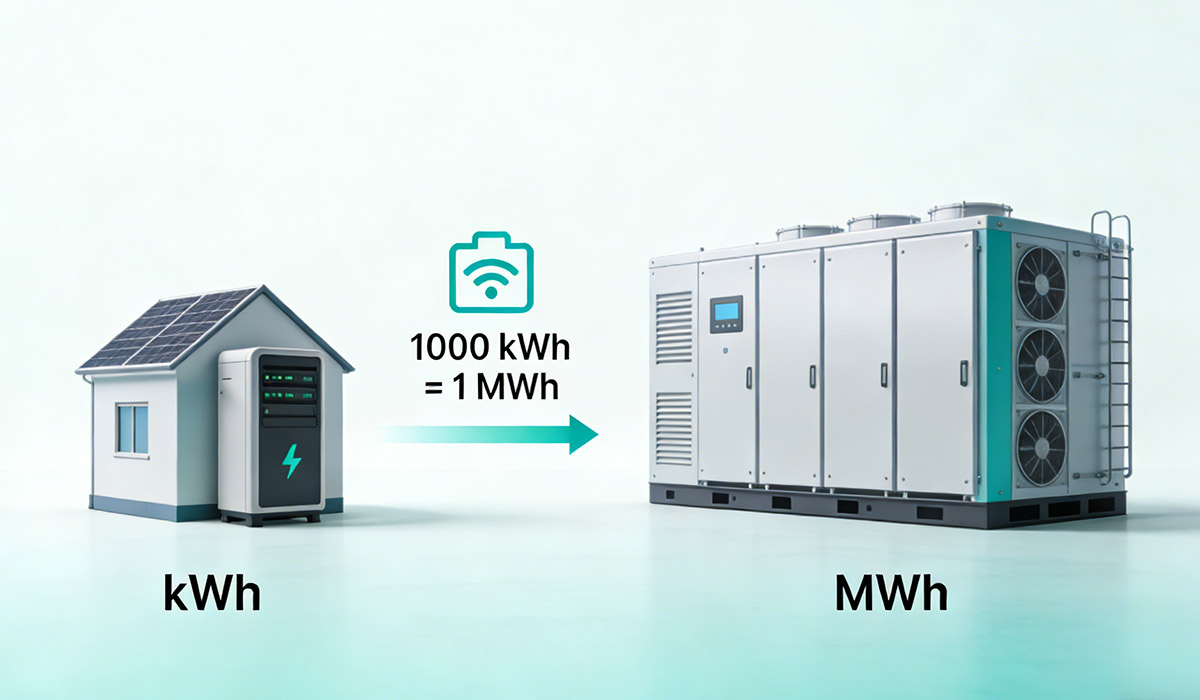
The conversion between these units is very straightforward:
1 MWh = 1,000 kWh
That means:
1 kWh = 0.001 MWh
1,000 kWh = 1 MWh
So if you want to convert kWh to MWh, just divide by 1,000.
If you want to convert MWh to kWh, multiply by 1,000.
This rule applies across all power calculations, whether you’re working with megawatt to kilowatt, kilowatt to megawatt hour, or even pricing models like $/kWh to $/MWh.
kWh vs MWh: What’s the Real Difference?
Many people confuse kWh vs MWh, but the difference is scale, not complexity.
kWh is typically used for homes, batteries, and small solar systems.
MWh is used for factories, utilities, data centers, and grid-scale energy storage.
For example:
A home battery might store 10–20 kWh
A commercial system may store 500 kWh to several MWh
This is why you’ll often see terms like megawatt hour, mwh electricity, or megawatt vs kilowatt when discussing large-scale energy.
How Many kWh Are in a MWh? (Real Examples)
This is one of the most searched questions online:
How many kWh are in a MWh?
The answer is always:
👉 1 MWh = 1,000 kWh
Examples:
5 MWh = 5,000 kWh
0.5 MWh = 500 kWh
2.5 MWh = 2,500 kWh
This applies whether you’re calculating mwh to kwh, kwh in mwh, or conversion kwh mwh for energy reports.
kW, kWh, MW, and MWh – Don’t Mix Them Up
A common mistake is mixing power (kW / MW) with energy (kWh / MWh).
kW (kilowatt) = power (how fast energy is used)
kWh (kilowatt-hour) = energy over time
MW (megawatt) = 1,000 kW
MWh (megawatt-hour) = 1,000 kWh
So when asking how many kW in a MW, the answer is 1,000 kW.
But when asking how many kWh in a MWh, the answer is 1,000 kWh.
This distinction is critical when doing kWh to MW conversion, MW to MWh conversion, or system sizing.
Real-World Example: Energy Storage Systems
In energy storage projects, clarity matters. A residential system may be rated at 10 kWh, while a commercial battery could be 100 kWh or 1 MWh.
For example:
A 1 MWh battery can power about 40–50 homes for one hour, depending on usage.
Industrial projects often calculate load using MWh per day.
That’s why professionals often switch between kWh and MWh when designing solar + storage solutions.
kWh to MWh Conversion Formula (Simple Version)
Use this anytime:
MWh = kWh ÷ 1000
kWh = MWh × 1000
This works for:
kWh to MWh conversion
mWh to kWh conversion
megawatt hour to kilowatt hour
No complex calculator required.
Final Thoughts: Why This Conversion Matters
Understanding kWh to MWh conversion helps you:
Read energy bills accurately
Compare battery systems correctly
Communicate clearly with installers and engineers
Avoid costly misunderstandings
Whether you’re calculating how many kWh in a MWh, comparing kWh vs MWh, or sizing an energy storage system, mastering this simple conversion gives you real power — literally.


How Can We Help?
Contact